ICS2 Explained: Answering 5 Key Questions to help you to be prepared
As from 1 March 2023 Release 2 of the EU ICS2 regulation has taken effect. It brings some additional obligations when shipping parcels to the EU. Want to find out the latest updates on Release 2 and the outlook of Release 3? Discover it all in the interview with Landmark Global’s expert Peter Smet.
Do you occasionally or frequently handle cross-border parcel shipping from outside the EU to an EU Member State, Northern Ireland, Switzerland or Norway? Then ICS2 might not be all new to you. Since 1 March, Release 2 of this European legislation has come into play, bringing along additional obligations. These mainly involve submitting an Entry Summary Declaration (ENS) for EU customs clearance prior to shipping any parcel to your EU customers. We asked expert Peter Smet, Director Trade Services Europe at Landmark Global to give us an update on ICS2 and explain the most important aspects and consequences for you as an e-tailer.
Can you describe in a nutshell what ICS2 is about?
‘ICS2 – Import Control System 2 - is the EU customs advance cargo information system. It has been put in place to protect the EU’s citizens and the internal market against safety and security threats. ICS2 gathers data on all goods destined to enter or transit via the EU before they reach the EU’s external borders. Norway, Northern Ireland and Switzerland are also included in its regional scope. This means all operators involved in transporting goods towards the EU are impacted, including all those who manage international parcel shipping, such as e-tailers. Custom authorities use the data in ICS2 to do targeted risk assessments, thus allowing them to early identify high-risk parcels needing extra scrutiny before entering the EU.’
What is the impact of Release 2 compared to Release 1?
‘ICS2 Release 2, as did Release 1, has an impact on shipments transported by air. What’s new in Release 2 is the fact that the ENS that needs to be sent to the EU authorities in advance of shipping a parcel is now a complete ENS instead of a minimum one. Thirdly, on top of postal operators and air carriers, also freight forwarders have a notifying obligation, while e-tailers need to inform the freight forwarder.’
Why should I bother complying with Release 2 of ICS2 as an e-tailer?
‘As an e-tailer, you have every interest in being compliant with this new regulation. That is if you like to see the parcels you ship to the EU by air arrive (on time) at your customer's doorstep. And I suppose that’s what it’s all about. The administration involved in ICS2 Release 2 may seem complex, but with the help of Landmark Global or one of our partners, the extra work for your business will be limited.’
What is the meaning of EORI and ENS, two terms often mentioned in relation to ICS2?
‘The EORI-number is a EU granted unique identification number used by EU custom authorities to identify your business. You apply for it in the initial EU-country you want to send goods to. The ENS (Entry Summary Declaration) dataset consists of identification of the sender and receiver of an item, its weight, a precise description and a HS commodity code (selected from an harmonised list established by the World Customs Organisation). These are in fact all data you already provide us with today when preparing a shipment.’
Can you briefly outline what actions I need to take as an e-tailer?
‘You share all ENS entries linked to items you want to ship with Landmark Global or an appointed service provider. They check ENS entries formally for completeness. Complete entries are automatically forwarded to EU authorities. Is an entry accepted, you get an ASSESSMENT COMPLETE message and you can ship your parcel. If an item is not accepted by the EU authorities, you wil be notified by a request to provide more information or to apply for a security screening. You might also receive a Do Not Load (DNL) message, meaning you cannot ship the item. You then have to check whether your ENS entry needs to be adjusted, or review whether your parcel is suitable for sending to the EU.’
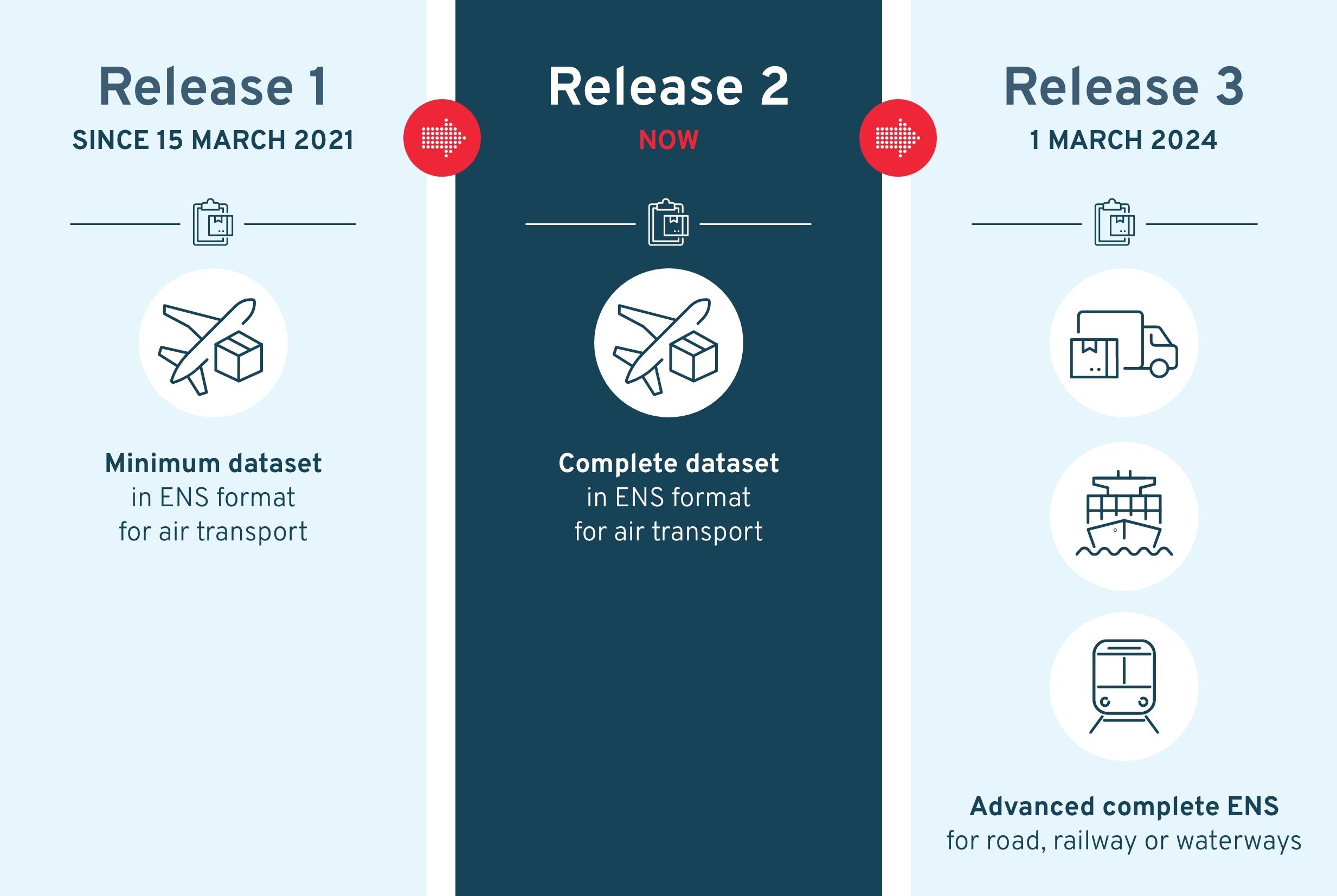
What are the timelines for all ICS2 releases?
- In Release 1, effective since 15 March 2021, express carriers and postal operators needed to electronically provide a minimum dataset in ENS format, for all goods they were responsible for bringing into the EU by air.
- In Release 2, effective sinds 1 March 2023, express and air carriers, postal operators and freight forwarders, need to provide a complete dataset in ENS format for all goods in air transport. Please note! Following EU-countries have been admitted a derogation to deploy Release 2 by 30 June 2023 only: Austria, Belgium, Denmark, Estonia, France, Greece, Croatia, Luxemburg, Netherlands, Poland, Romania, and Sweden.
- In Release 3, becoming effective on 1 March 2024, goods brought into the EU by road, railway or via waterways will additionally be subject to an advanced complete ENS.
More information on ICS2? Consult the EU website.