
Top 10 Essential Facts About US Ecommerce (2026 Edition)
Key points
- The US ecommerce market has crossed the $1.23 trillion milestone, confirming its place as the world's second-largest online retail market.
- 288 million Americans now shop online, spending an average of $4,280 per year, as digital retail continues to embed itself across every demographic.
- Mobile is the dominant shopping device, smartphones driving 58% of cross-border purchases, making a mobile-first experience table stakes for any retailer entering the market.
- Consumer expectations are firmly set around transparency, trust and speed: from upfront delivery costs to reliable tracking, every touchpoint shapes conversion.
In 2026, the US remains a global ecommerce powerhouse second only to China with a digitally savvy consumer base that demands speed, clarity and seamless service. For cross-border retailers, understanding the nuances of this market is no longer optional but a prerequisite for success.
As Landmark Global originally began as an American company (today part of the Belgian bnode group), we bring deep expertise and unique advantages in serving the US and Canadian markets. Here are the top 10 facts every ecommerce professional needs to know about the US market this year.
US E-commerce in 2026
1. The US ecommerce market is worth $1.23 trillion
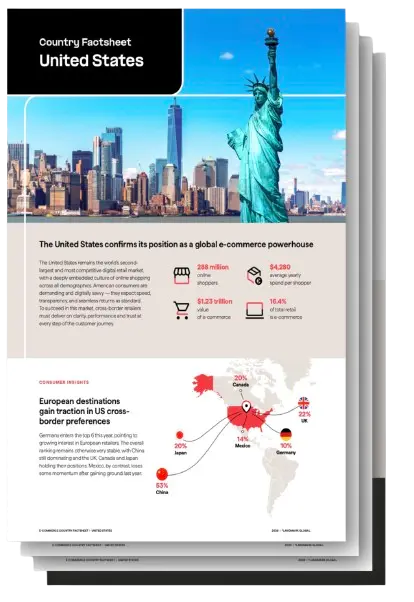
The United States has firmly established itself as a trillion-dollar ecommerce economy. According to the Landmark Global 2026 Country Factsheet (based on US Census Bureau data), the market is now valued at $1.23 trillion, with online sales accounting for 16.4% of total retail, a figure that has climbed steadily year on year.
While this represents a recalibration from some of the more inflated post-pandemic estimates, the underlying trajectory is consistent and confident. Industry analysts at Mordor Intelligence estimate the US ecommerce market at around $1.38 trillion in 2026 when broader commerce categories are included, with the sector projected to reach $2.28 trillion by 2031 at a 10.5% CAGR. The message is clear: America's digital retail engine is running strong.
2. 288 million Americans shop online
Online shopping in the US is no longer a niche behaviour but effectively mainstream. The country now counts 288 million active online shoppers, representing approximately 86% of the total population. This near-universal digital adoption means that:
First-time shopper acquisition is no longer the challenge; retaining and converting existing shoppers is where the real battle is fought.
For cross-border retailers, this represents an enormous, mature addressable audience. The task is not to convince Americans to shop online, but to convince them to shop with you.
3. The average American spends $4,280 online per year
US consumers are high-value shoppers. With an average annual online spend of $4,280 per shopper, the US sits among the world's most lucrative ecommerce audiences. This figure, derived from total market value divided by the number of active shoppers, reflects a consumer culture deeply comfortable with online transactions of all sizes.
The trend within cross-border shopping is also moving upmarket: orders above $80 are growing in share, while lower-value purchases are declining. High-value baskets now dominate, with 57% of cross-border orders falling in the $55+ range. Retailers offering premium or differentiated products are well positioned in this environment.
4. Clothing leads cross-border purchases, but accessories and everyday products are gaining fast
Product category preferences reveal a lot about American cross-border shoppers. Clothing and footwear continues to dominate at 46% of cross-border purchases but the mix is shifting. Accessories (jewellery, watches, bags) have moved into second place at 27%, overtaking personal care and beauty (24%).
Notably, food and beverage has entered the top categories at 21%, pointing to a growing appetite for international lifestyle products. Consumer electronics (19%) and household appliances (14%) round out the list. For international brands, the key takeaway is that US shoppers are open to discovering products across an increasingly broad range of everyday categories, not just fashion.
5. Fast delivery is the #1 driver of cross-border purchases
Speed sells. 41% of US cross-border shoppers cite fast delivery as their primary reason for purchasing internationally and this advantage is widening. Easy product discovery (34%), low prices (32%), wider product choice (31%) and reliable delivery (30%) complete the top five.
This ranking has significant strategic implications. US consumers are not choosing international retailers despite slower delivery — they are actively seeking retailers who can match the speed standards set by domestic giants like Amazon. According to Mordor Intelligence, same-day and next-day delivery expectations are now reshaping supply chains across the sector, with micro-fulfilment centres increasingly deployed to close the gap.
Did you know?
88% of American online shoppers track their parcel via notifications — one of the highest rates globally. That means delivery visibility isn't a nice-to-have; it's a baseline expectation.
Download our 2026 US Ecommerce Country Factsheet to discover what else American shoppers demand from cross-border retailers.
6. Smartphones dominate: 58% of cross-border purchases are made on mobile
Mobile commerce is not the future; it is the present. Smartphones account for 58% of cross-border online purchases in the US, widening their lead over laptops (21%), desktops (13%) and tablets (8%). This figure aligns with broader market data: Mordor Intelligence reports that smartphones drove 71.8% of all US ecommerce transactions in 2025, growing at an 11.85% CAGR.
For retailers, this means that mobile UX is a revenue-critical investment, not a secondary concern. Checkout friction, page load times, and mobile payment options (Apple Pay, Google Pay) directly impact conversion in this market.
7. Transparency and trust are the pillars of the US delivery experience
American consumers have high expectations and they are pretty specific about what they need before clicking "buy." According to the Landmark Global Factsheet, 91% of US shoppers want clear delivery cost information before purchase, 88% rely on customer reviews, 87% want a simple return process, 85% value trust in the delivery provider, and 84% expect free delivery above a certain threshold.
These numbers are not aspirational benchmarks but baseline requirements. Any retailer entering the US market without addressing these five pillars will face a significant conversion handicap. Transparency at checkout is, quite simply, the price of entry.
8. 88% of US shoppers track their parcels via notifications
Americans are active participants in the delivery journey. A striking 88% of US online shoppers follow their parcel via tracking notifications which is one of the highest rates globally. This level of engagement reflects both technological comfort and high delivery expectations: consumers want visibility from dispatch to doorstep.
Home delivery remains the clear preference, with 56% opting for doorstep delivery and 22% choosing mailbox delivery. Collection points and parcel lockers remain marginal (5% combined), confirming that last-mile home delivery is non-negotiable for success in this market.
9. European brands are making their mark — Germany enters the top 6
The cross-border competitive landscape is evolving. While China continues to dominate with 53% of US cross-border shoppers purchasing from Chinese retailers, Germany has entered the top 6 this year: a notable development for European brands eyeing the American market.
The UK (22%), Canada (20%), Japan (20%) and Mexico (14%) round out the rankings, with Mexico losing some momentum after strong gains in 2025.
Germany's entry signals growing US consumer interest in European craftsmanship and brand values, a genuine window of opportunity for European retailers willing to invest in the logistics infrastructure needed to compete.
10. Sustainability is on the US shopper's radar and expectations are rising
Environmental consciousness is becoming a meaningful factor in the US ecommerce experience. According to the Landmark Global Factsheet, 72% of US shoppers already recycle the packaging they receive, 63% prefer retailers to use recyclable materials, 61% are willing to accept slower delivery to reduce environmental impact, and 55% dislike over-packaged orders.
This is not yet the primary decision-making driver — speed and price still lead — but the direction of travel is clear. Retailers who proactively communicate their sustainability credentials, from packaging choices to carbon-neutral delivery options, are building a competitive advantage that will matter increasingly as consumer awareness grows.
Final Thoughts
The US ecommerce landscape in 2026 is simultaneously enormous and demanding. With 288 million active shoppers, a $1.23 trillion market and expectations set firmly around speed, transparency and trust, there is genuine opportunity for international retailers.
For cross-border brands, the playbook is clear: invest in mobile, be transparent at checkout, deliver fast and reliably, and communicate your sustainability story. The American shopper is not forgiving of friction but they are extraordinarily loyal to brands that get it right.
Sources:
- IPC Cross-border E-commerce Shopper Survey 2025 – US Report
- US Census Bureau, Quarterly Retail E-Commerce Sales Q4 2025: https://www.census.gov/retail/ecommerce.html
- Mordor Intelligence, US Ecommerce Market Size & Forecast 2026–2031: https://www.mordorintelligence.com/industry-reports/united-states-ecommerce-market
- Charle Agency, 50+ Ecommerce Statistics for 2026: https://www.charleagency.com/articles/ecommerce-statistics/