
Top 10 Essential Facts About E-Commerce in Canada in 2026
Canada is an open cross-border market. Around 31 million people shop online there, and the market is worth US$65 billion. What makes Canadian e-commerce unusual is where the money goes. More than half of those shoppers buy from retailers outside the country.
The ten facts below come from our Country Factsheet for Canada and cover what Canadians buy, why they buy abroad and what they expect once the parcel is moving. Read on.
Key Points
- US$65 billion online market size, with e-commerce accounting for 41% of total retail.
- 55% cross-border buying rate among Canadian online shoppers.
- Fast delivery and reliability outranking low prices as key buying drivers.
- Clothing and footwear leading cross-border category share, followed by personal care and beauty.
- Upfront cost transparency required before checkout by 91% of shoppers.
- Shift in delivery preferences towards safe-place drops and parcel lockers over post office pickups.
Canadian E-Commerce in 2026: 10 Key Facts
1. Canada Is a US$65 Billion Online Market
Canadian shoppers spend US$65 billion online, and e-commerce accounts for 41% of total retail. Around 31 million people in Canada buy online. Growth is steady.
2. More Than Half of Canadians Buy From Abroad
55% of Canadian online shoppers buy cross-border. They are after variety and value they cannot find at home.
60% of them buy from US retailers and 51% from Chinese ones. The United Kingdom is named by 15%, France by 9%, Australia by 7% and Japan by 6%. France and Australia both gained ground this year, the UK and China held steady, and the US share declined.
What This Means for Sellers Outside Canada
Canadians already buy from abroad by default, removing the primary barrier for exporters. To capitalize on e-commerce in Canada in 2026, sellers must solve border clearance and shipping reliability.
Landmark Global provides international parcel delivery using a carrier-neutral model, selecting between postal and commercial networks based on lane and cost. Dedicated in-house customs teams in Canada handle B2C and B2B clearance, DDP and DAP, and trade compliance without third-party broker handoffs.
3. Speed Leads, and Reliability Has Overtaken Price
Fast delivery is the main reason Canadians buy from foreign retailers, named by 42%. A wider choice of products and brands follows at 35%.
Reliable delivery has climbed to 34%, above low product prices at 32%. Easy product discovery scores 31% and cheap delivery cost 28%. Reliability now outranks price.
4. Clothing and Footwear Is the Biggest Category
Clothing and footwear appears in 42% of Canadian cross-border purchases. Its lead grew again.
Personal care and beauty have overtaken consumer electronics for second place at 18%, with electronics at 17%. Sport, leisure and hobbies takes 13%, home and garden 12%, toys 11%. Books, music and media continue to decline.
5. Half of Cross-Border Orders Are Worth US$50 or More
Orders of US$50 or more make up 51% of Canadian cross-border purchases, and the share is still rising. The US$25 to US$54 band takes 26%. US$10 to US$24 takes 18%, and anything under US$10 takes 5%.
6. Most Parcels Weigh Between 0.6 and 2 kg
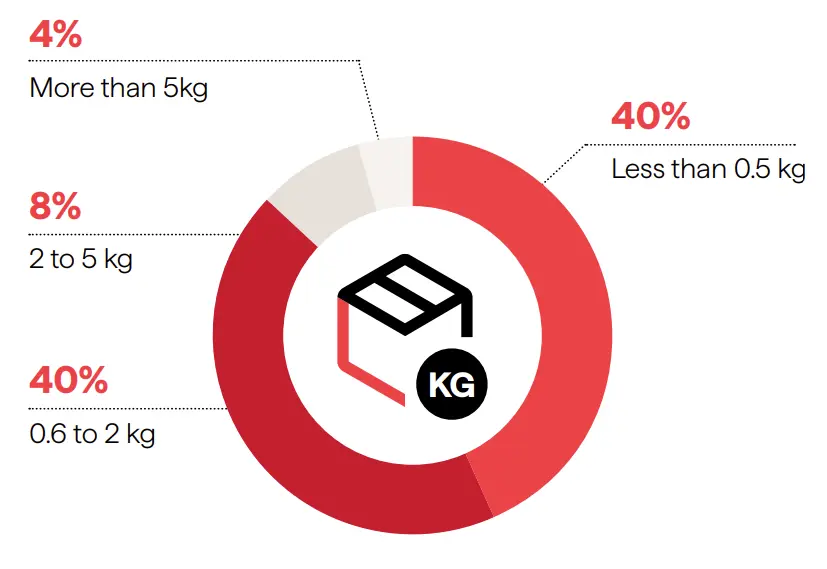
Parcels between 0.6 kg and 2 kg are now the most common at 48%. They have overtaken ultra-light items under 0.5 kg, which sit at 39%. The 2 kg to 5 kg range takes 9% and anything above 5 kg takes 4%. Heavier shipments held steady.
7. Smartphones Are the Primary Shopping Device
Canadians use smartphones for 47% of online shopping, and the share edges up again. Laptops take 25%, desktops 20%, tablets 8%. Laptop purchases slipped this year.
8. Home Delivery Leads, but Pickup Options Are Gaining
78% of Canadians want delivery to the door, and most name more than one acceptable option: mailbox delivery 61%, post office collection 35%, a safe place at home 27%, postal service points 18% and parcel lockers 15%. Post office pickups fell this year, safe-place delivery and lockers rose.
Delivery Choice on Canadian Lanes
Landmark Global delivers to the doorstep or to a pickup location the customer selects. Every shipment is integrated and tracked end to end through Mercury, our single proprietary technology platform connecting customer systems via API or FTP. Landmark Global's returns management service handles label generation, first-mile transport, in-country consolidation, and customs clearance on the reverse leg on the same tracking feed as the outbound parcel.
9. Cost Clarity Decides Whether the Sale Closes
Clear information about delivery charges before purchase is the highest expectation among Canadian shoppers, at 91%. Reliable customer reviews follow at 88%, low customs duties at 87%, free delivery above a set order value at 85% and a simple returns process at 85%. 81% of Canadians follow their parcel through delivery notifications.
10. Sustainability Is Part of the Delivery Decision
Environmental awareness is already routine in Canada. 83% of shoppers recycle their parcel packaging and 68% want retailers to use recyclable materials. Over-packaging annoys 65%. 61% will accept a slower delivery if it reduces environmental impact.
Did You Know?
| Category / Flow | Duty Threshold | Tax Threshold |
|---|---|---|
| General De Minimis (Global) | CAD 20 | CAD 20 |
| US/Mexico Courier Shipments | CAD 150 | CAD 40 |
CETA can remove the duty on qualifying EU-origin goods. The exporter adds a statement on origin to the commercial invoice, and shipments above EUR 6,000 need a REX number. Get that wrong and the shopper pays at the door.
Our Country Factsheet for Canada covers what drives Canadian consumers and how the parcel profile is changing. Download it to get the full picture.
Landmark Global on Canadian Lanes
| Feature: what Landmark Global runs | Advantage: what it changes | Benefit: what you get |
|---|---|---|
| Delivery to 220+ destinations, with local teams and local carrier knowledge | You enter Canada without building a separate carrier setup for the market | Faster market entry and fewer operational handoffs |
| Carrier-neutral routing across postal and commercial networks, selected per country and service level | You are not locked into one network when Canadian delivery preferences shift | A delivery mix that matches how Canadians want to receive parcels |
| In-house customs teams in Belgium, the UK and Canada, covering HS classification, DDP and DAP | The team that routes the parcel also clears it, so a query has one owner | Duty and tax settled before the door, which is what 87% of Canadians ask for |
| Mercury, one integration by API, FTP or web for shipping, tracking, reporting and accounting | One connection replaces a separate integration for every network you use | Connect once and add markets without new IT work each time |
| Returns with in-country consolidation and customs clearance on the reverse leg | Returns run through the same tracking as the outbound parcel, instead of a separate process | The simple returns process that 85% of Canadian shoppers ask for |
| Specialist onboarding and named account management | You test a lane before committing volume to it, and you keep the same contact afterwards | Support that adapts as your Canadian volumes grow |
The Takeaway
Canadian e-commerce rewards sellers who treat delivery as part of the offer. Speed is what brings Canadians to a foreign store. Clear landed costs, reliable transit times, a choice of collection point and returns that work decide whether they buy again.
As part of Bnode (formerly bpostgroup), Landmark Global combines decades of logistics history with a dedicated cross-border setup to ensure operational reliability on high-volume lanes.
Ready to expand your cross-border reach without building a multi-carrier setup? Talk to Landmark Global about establishing a test lane for Canadian Volume. A dedicated onboarding team will help benchmark your carrier selection, configure Mercury API or FTP integrations, and conduct a customs review of your product range before go-live.
Are you interested in other markets? Canada's biggest source market has its own edition, in our top 10 facts about US e-commerce, and you can browse the full set of country reports.
Sources:
- Landmark Global Country Factsheet Canada 2026, based on Statista, Trade.gov and the IPC Cross-border E-commerce Shopper Survey 2025, Canada report
- Canada Border Services Agency, Memorandum D8-2-16, Courier Imports Remission
- EU-Canada Comprehensive Economic and Trade Agreement, origin declaration and registered exporter requirements
Frequently Asked Questions
-
Variety and value they cannot get domestically. 55% buy cross-border, and the reasons they give are led by fast delivery at 42% and a wider choice of products and brands at 35%.
-
Cost transparency. Clear delivery charges before purchase is the top expectation at 91%, and low customs duties follow at 87%. Show a landed cost that includes duty, then hold the delivery date you quoted.
-
Doorstep delivery above all, preferred by 78%, with mailbox delivery at 61%. Beyond that, expect demand for choice. Post office collection, safe-place drops, postal service points and lockers make up the rest, and the out-of-home options are growing.