How to Prevent Abandoned Carts in E-Commerce? Proven Strategies
Cart abandonment is one of the most persistent issues in the e-commerce sector. While it cannot be eliminated entirely, minimizing cart abandonment is key to scaling profitability. Why does it remain such a hurdle in 2026, and what concrete steps can you take to decrease it? Find out in this updated guide!
Key points:
- The average e-commerce cart abandonment rate remains a critical challenge, hovering around 70.22%, meaning businesses could significantly increase their revenue by solving this problem.
- The most common reasons for cart abandonment fall into three main categories: logistics (e.g., slow delivery, inconvenient returns), pricing (e.g., high shipping costs, unexpected duties and taxes at checkout), and user experience (e.g., website errors, lack of localized payment options).
- With the 2025/2026 global customs changes - such as the US suspending the $800 de minimis threshold and the EU eliminating the €150 duty exemption - transparent pricing including Landed Cost calculations (DDP) has become vital to prevent cart abandonment.
- To reduce abandonment rates, businesses should optimize their e-commerce delivery operations with experienced fulfillment partners, maintain absolute price transparency, and ensure website speed and payment variety.
The Problem of Cart Abandonment
55%, 79.53%, 84.27%, 74%, and so on and so forth… It’s impossible to determine the exact rate of cart abandonment in e-commerce stores, as each source measures different stores in varying time periods. All of the numbers we mentioned are true according to some research. But do they prove anything?
Yes - they show how big of an issue cart abandonment is. According to Baymard Institute, which collects data on this specific problem, the average across 50 different sources and measurement times equals… 70.19%. The lowest score found was 55% (from 2010), while the highest equaled 84.27% (from 2020). Even if we take the average, this means that if you were to eliminate abandoned baskets, you would triple your income. So, abandoned carts are a major problem, and the better your solution, the more profitable your online store.
12 Most Common Reasons for Shopping Cart Abandonment
Finding the solution requires a good understanding of the problem, which in turn means that you have to know what causes cart abandonment in your e-commerce store.
- 42% - I was browsing / not ready to buy
- 40% - Extra costs too high (shipping, etc.)
- 20% - Delivery was too slow
- 19% - I didn’t trust the site with my credit card
- 18% - Had to create an account
- 17% - Too long/complex checkout process
- 17% - Website had errors/crashed
- 13% - Return policy wasn’t satisfactory
- 12% - I couldn’t see total order cost upfront
- 10% - The credit card was declined
- 9% - There weren’t enough payment methods
- 7% - I don't know
Based on this, we can divide the problem into three categories:
- logistics,
- pricing,
- UX.
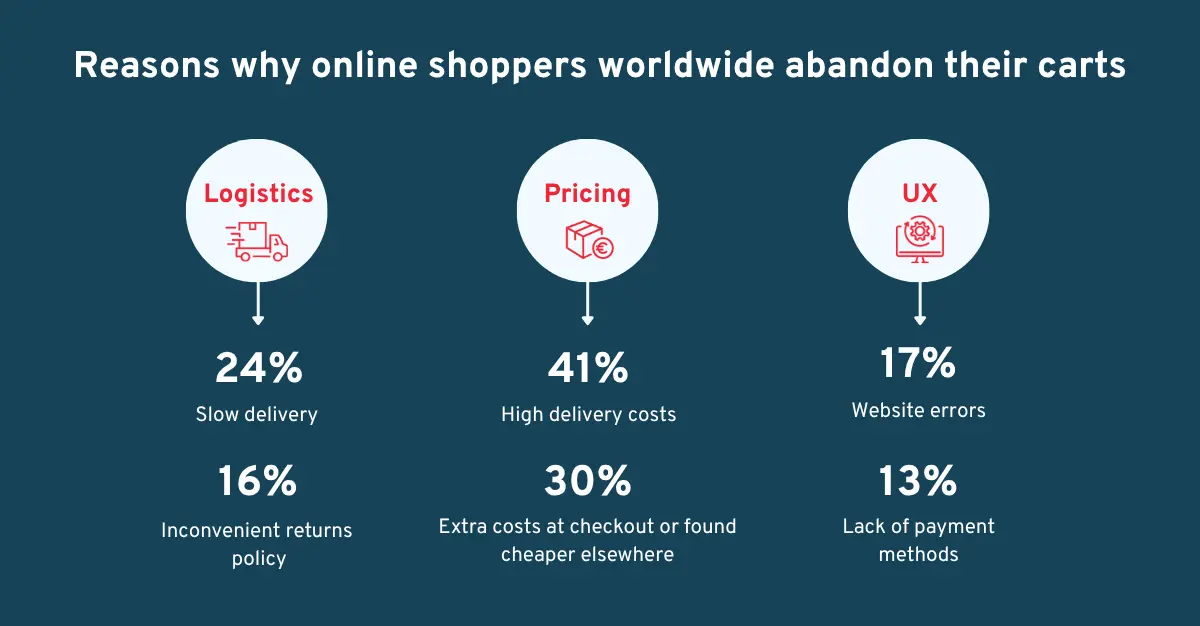
How to reduce cart abandonment rates in your store? You need to address the challenges related to each of these categories.
Proven Ways to Reduce Cart Abandonment
Addressing these challenges requires a strategic approach across all three categories. Here is what is working in today's e-commerce landscape:
Logistics
First, let’s look at logistics. In this case, your main problems are: return policies and delivery speed. The answer to both of them is simple: partner with an experienced international logistics company, such as Landmark Global. How can we help you overcome these challenges?
- Delivery speed - as a part of the Bpostgroup, we have access to multiple storage and fulfilment facilities across the globe. Thanks to this, you can inject your products into the target market earlier on and provide your customers with delivery speed comparable to that of local e-commerce stores. Our infrastructure is located strategically to optimise routes and ensure maximum coverage in European, North American and Asian countries.
- Returns policy - having gathered extensive experience, we provide you with efficient and effective returns management solutions. You can build your policy around them, ensuring that returns are convenient for your shoppers and cost-efficient for your store.
Pro tips:
- Create a returns policy slightly longer than the legal requirements - this will attract customers to your store.
- Delivery speed is one of the main reasons for cart abandonments worldwide but it’s not always the main one. In many markets, consumers care more about aspects like their trust in the carrier company, delivery sustainability or flexible delivery methods - you need to know each specific market inside-out and adapt to customer expectations.
Pricing & Cross-Border Transparency
Surprise costs at checkout are the single biggest conversion killer. In 2026, global trade changes mean international buyers are frequently surprised by unexpected import fees:
- Global Customs Changes: With the US suspension of the $800 de minimis exemption and the EU's €3 flat customs duty on low-value parcels, cross-border shoppers face duties on almost all imports. If these fees are not calculated at checkout, buyers abandon their carts or refuse packages at the door.
- Implement Landed Cost Calculations (DDP): Use Delivered Duty Paid (DDP) shipping solutions to display all duties, taxes, and shipping fees upfront. Showing the total cost at checkout eliminates "sticker shock."
- Offer Free Delivery Thresholds: Encourage higher order values by offering free shipping over a specific cart amount.
- Optimize Delivery Networks: Utilize optimized e-commerce delivery solutions to reduce base freight costs.
User Experience (UX)
In terms of user experience, it all goes down to your website. Make sure it performs well, with acceptable page loading speeds and hire a developer to manage your store - they’ll be able to detect and react to errors quickly, before these impact your conversions. You should also work with a specialised payment processing company that can provide you with a diverse range of payment options adjusted to the target market (e.g., in Germany consumers love invoices that can be paid for in up to 14 days post-delivery - you should have such an option if you want to penetrate this specific market).
The Takeaway
You won't be able to prevent all cart abandonments in your shop - sometimes users just use them as their wishlists, or simply find the product cheaper at a different store. However, if you adopt the strategies we discussed, you will reduce cart abandonment rates significantly, letting your e-commerce store thrive. After all, it’s easier (and cheaper) to keep customers engaged and make them convert, rather than to attract new users to your store!
You may also read:
References:
- https://baymard.com/lists/cart-abandonment-rate
- https://www.statista.com/statistics/1383326/reasons-for-cart-abandonment-worldwide/
- https://www.avalara.com/blog/en/north-america/2024/11/de-minimis-exemption-changes-coming.html
- https://taxation-customs.ec.europa.eu/news/guidance-and-legal-text-temporary-flat-fee-low-value-imports-which-will-apply-until-1-july-2028-2026-06-08_en
FAQ
-
According to data collected by the Baymard Institute from 50 different sources, the average shopping cart abandonment rate is 70.22%. This highlights a major loss of potential revenue for e-commerce stores.
-
The primary reasons for cart abandonment at checkout are users simply browsing or not ready to buy (42%), extra costs being too high such as shipping, taxes, and fees (40%), and delivery being too slow (20%). Other significant drivers include a lack of trust in site security (19%), being forced to create an account (18%), an overly long or complex checkout process (17%), website errors or crashes (17%), unsatisfactory return policies (13%), inability to see the total order cost upfront (12%), declined credit cards (10%), and a lack of preferred payment methods (9%).
-
To address shipping-related cart abandonment, stores can partner with an international logistics company to improve delivery speed and offer convenient returns. Additionally, being transparent about all costs, offering free delivery above a certain order value, and using optimized delivery solutions can help reduce high shipping costs.
-
Poor user experience is a key driver of cart abandonment. Issues such as website errors, slow page loading speeds, and a lack of satisfactory payment options can frustrate customers and cause them to leave before completing a purchase. Improving website performance and offering payment methods tailored to the target market can significantly reduce abandonment.