
The Guide for Shipping Electronics Internationally
Shipping electronics internationally as a business starts with two checks for every product: how its battery is classified for transport and what the destination market requires before you can sell it there. Customs data and packing follow from those two answers. For B2B shippers, this guide covers the 2026 lithium battery rules, the documents a commercial shipment needs, EU producer registrations and how to handle returns and demo units.
Key Takeaways
- Since 1 January 2026, lithium-ion batteries packed with equipment must fly at no more than 30% charge.
- Every lithium battery type needs a UN38.3 test summary from the manufacturer or distributor.
- Many IT products are duty-free under the WTO Information Technology Agreement, but import VAT still applies.
- Selling electrical goods to consumers in another EU country requires WEEE and battery registration there.
- Serial numbers recorded at dispatch prove that a returned unit is the same item.
Why Is Shipping Electronics Harder Than Other Goods?
Electronics combine four risks in one parcel. Most contain a lithium battery, which makes them dangerous goods in transport. They are valuable and attract theft. Circuit boards are sensitive to static and shock. And most are regulated products in the destination market. Even a well-packed shipment can be refused at the airport or held at customs if the battery or product data is wrong.
How to Ship Electronics Internationally With Lithium Batteries
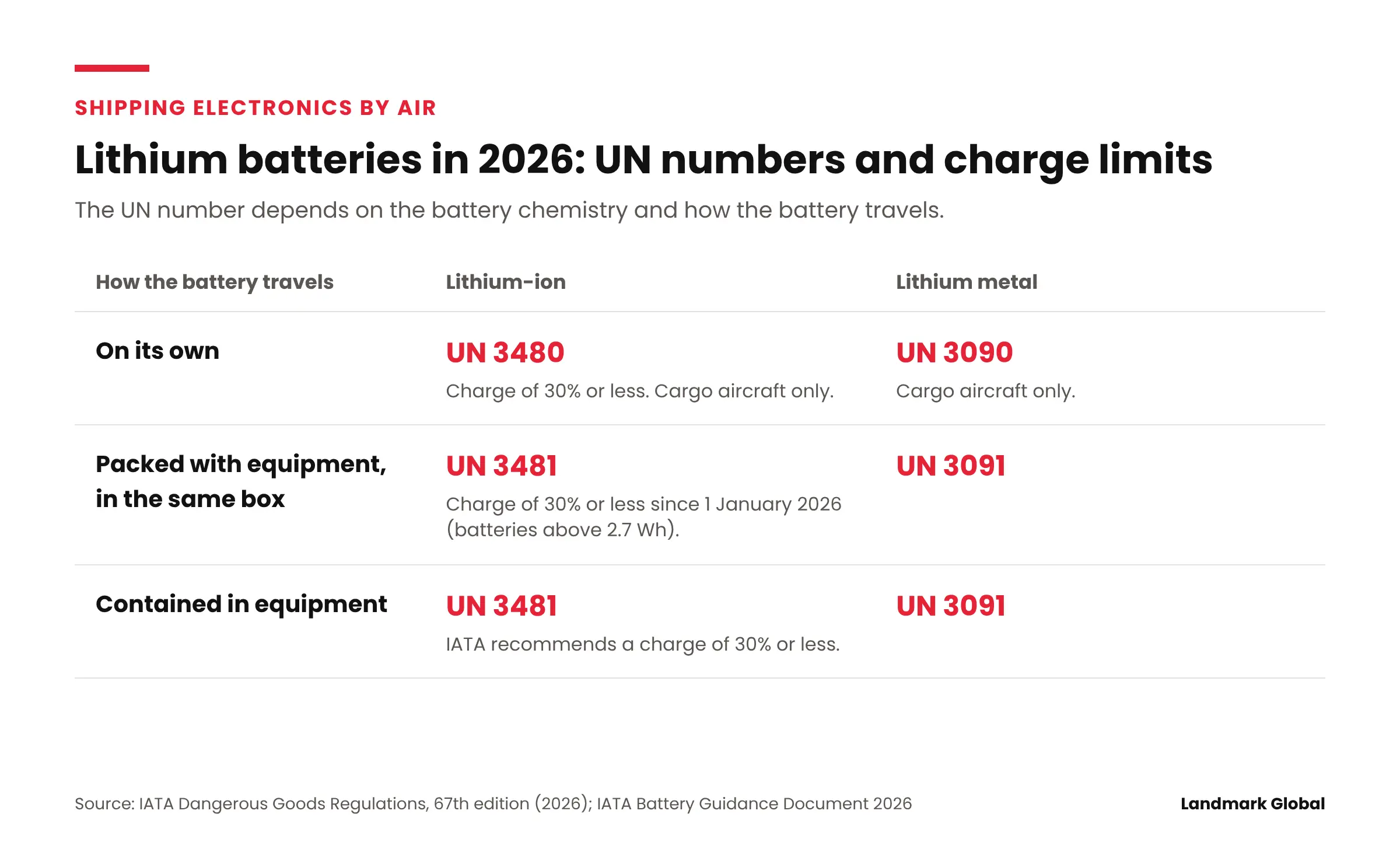
Air transport follows the IATA Dangerous Goods Regulations, where the UN number depends on battery chemistry and on how the battery travels.
| How the battery travels | Lithium ion | Lithium metal |
|---|---|---|
| On its own | UN 3480 | UN 3090 |
| Packed with equipment, in the same box | UN 3481 | UN 3091 |
| Contained in equipment | UN 3481 | UN 3091 |
Smaller lithium-ion batteries packed with or contained in equipment, up to 20 Wh per cell and 100 Wh per battery, can ship under Section II of the packing instructions, with the lithium battery mark and no full dangerous goods declaration.
Since 1 January 2026, lithium-ion cells and batteries packed with equipment and rated above 2.7 Wh must be offered for air transport at a state of charge of no more than 30% of rated capacity. Batteries shipped on their own already had that limit and are forbidden as cargo on passenger aircraft. For batteries contained in a device, IATA recommends the same 30% limit. Charge the units to 30% or less before packing.
The manufacturer or distributor must also provide a UN38.3 test summary for each cell and battery type, so keep one on file per model. Road, sea and postal networks apply their own battery rules, so confirm carrier acceptance on each lane before promising delivery times. Landmark Global checks carrier acceptance and battery documentation requirements across its network before booking, so classification issues are flagged before a shipment reaches the carrier.
Which Documents Do You Need to Ship Electronics to a Different Country?
A commercial electronics shipment usually needs five sets of information.
- A commercial invoice with a plain product description, model number, HS code and country of origin for each line
- A packing list matching serial numbers to cartons on high-value consignments
- Battery information: UN number, watt-hour rating and the UN38.3 test summary
- EORI numbers for the exporter and the importer of record
- An export licence where the product falls under dual-use controls
Most electronics are classified in HS chapters 84 and 85. Many IT products, including computers, mobile phones and semiconductors, enter countries that have signed the WTO Information Technology Agreement duty-free, though import VAT still applies. Describe what each product is and what it does, and add the model number, so customs can classify it from the invoice. Landmark Global's in-house customs team reviews HS codes and EORI details at booking, matching the commercial invoice to the clearance declaration before the shipment reaches the border.
Read our guide to completing a commercial invoice.
Export controls apply to dual-use items. In the EU, Regulation (EU) 2021/821 sets the control list, which can catch products with strong encryption or specialised sensors. The UK runs its own regime, explained in our article on UK export licences.
Which Registrations Does the Destination Market Require?
Customs releases the goods, but market rules decide whether you can sell them. Electrical products sold in the EU need CE marking. Great Britain uses UKCA and still accepts CE marking for most consumer goods, as our comparison of UKCA and CE marking explains.
Selling to consumers in another EU country also makes you a producer there under the WEEE Directive. Register in each country you sell to, and if your business is not established there, appoint an authorised representative to do it for you. Since 18 August 2025, the EU Batteries Regulation adds a separate producer registration in each member state, which covers batteries built into devices. Register before the first order ships, because the obligation starts with the first unit sold.
How Should Electronics Be Packed for International Transit?
Pack for the roughest leg of the route. Put boards and loose components in anti-static bags and wrap each unit. Use a double-walled carton with no space for the product to move. Pack detachable accessories separately unless they ship in the retail box. A plain outer carton draws less attention than one printed with the brand and product.

Declare the real transaction value. An under-declared shipment risks customs penalties and is underinsured if it goes missing.
Returns, Repairs and Demo Units
Electronics also travel back as faulty units and demo stock. EU goods that return unaltered within three years of export can re-enter duty-free under Returned Goods Relief, provided you can prove they are the same items. Returned Goods Relief depends on proving that the item coming back is the one you exported. Record serial numbers when the goods leave.
For B2C sales imported into the EU, the €2 Union handling fee that applies from 1 November 2026 is not refunded when a customer returns the product. Demo units and trade show samples can travel on an ATA Carnet, a customs document that works like a passport for goods and stays valid for one year. Returns management brings faulty units back through one tracked flow.
Landmark Global ships e-commerce parcels to more than 220 destinations using a carrier-neutral model that selects from postal and commercial last-mile networks per route. For electronics, customs classification and serial-number tracking run under the same provider as returns.
| Feature: what Landmark Global runs | Advantage: what it changes | Benefit: what you get |
|---|---|---|
| Carrier-neutral access to postal and commercial last-mile carriers across 220+ destinations | Carrier selection is optimised per lane, with no single-network lock-in | Better cost and transit time per route, with alternative routing when a carrier is disrupted |
| In-house customs clearance with HS classification support | Descriptions and codes are checked by the team that clears the shipment | Fewer holds on high-value consignments |
| Fulfilment with lot and serial number control | Serial numbers are captured at pick and pack | Faster warranty checks, claims and returns relief |
| Returns management covering labels, first-mile transport, customs and final-mile delivery | Faulty units come back through one tracked flow | Repairs and refunds start sooner; B2C customers in Europe can drop off at PUDO collection points rather than waiting for courier collection |
| Mercury, one integration for shipping, tracking and reporting | Every market runs through the same connection | One data source for every lane |
| Specialist onboarding and a named account team | One person owns the setup | Questions about a lane reach someone who knows your products |
As part of Bnode, formerly Bpostgroup, Landmark Global works with the group's postal infrastructure.
Shipping electronics into a new market? Send Landmark Global your product list and parcel profile for a lane proposal with customs classification and returns included.
Sources:
- IATA, Lithium Battery Guidance Document 2026, https://www.iata.org/en/programs/cargo/dangerous-goods/lithium-batteries/
- REACH24H, IATA DGR 67th Edition Published: What Shippers Must Know Before January 1, 2026, https://en.reach24h.com/news/industry-news/chemical/iata-dgr-67th-edition-published
- WTO, Information Technology Agreement, https://www.wto.org/english/tratop_e/inftec_e/inftec_e.htm
- Directive 2012/19/EU on waste electrical and electronic equipment, Article 17 and Annex VI, https://eur-lex.europa.eu/legal-content/EN/TXT/?uri=CELEX:02012L0019-20180704
- Regulation (EU) 2023/1542 concerning batteries and waste batteries, Articles 55 and 96, https://eur-lex.europa.eu/legal-content/EN/TXT/?uri=CELEX:32023R1542
- European Commission, EU Customs Reform, https://taxation-customs.ec.europa.eu/customs/eu-customs-reform_en
- GOV.UK, Take goods temporarily out of Great Britain, https://www.gov.uk/taking-goods-out-gb-temporarily
Frequently Asked Questions
-
The shipper. Under dangerous goods rules, the party offering the goods for transport is responsible for classification, packing, marking and documents, even when a carrier or forwarder books the shipment. Staff who prepare battery shipments need training for that task.
-
For B2C orders, DDP usually works better, because the customer pays duties and VAT at checkout and receives the parcel without a charge at the door. B2B buyers often prefer DAP, since they import on their own account and can reclaim import VAT.
-
Yes, but you must show the goods are working products, not waste. The WEEE Directive requires a sales invoice, test records for each item, a declaration that nothing is waste and protective packaging. Faulty units sent for warranty repair follow lighter rules.