Market Expansion for E-Commerce: How to Begin and Is It Worth It?
Market expansion for e-commerce pays off when shoppers in the target country already buy from foreign stores and your margin survives duties and returns on that lane. You can check both before committing any stock. Start with one market, served from the warehouse you already run, and agree before launch which results will decide whether you stay. Tax registrations and returns usually weigh more on that margin than shipping rates do.
Key Takeaways
- You can measure cross-border demand before launch, in your analytics and in published shopper surveys.
- Shipping from your existing warehouse lets you test a market without placing stock there.
- Tax and product registrations must be in place before the first order ships.
- Delivery options and local payment methods decide conversion alongside product price.
- Expansion pays when conversion and landed cost per order meet targets set before launch.
Is Market Expansion Worth It for an Online Store?
It is worth it when the demand already exists, and across European markets it often does. This guide treats market entry across Europe, with the UK included as a leading cross-border destination for EU sellers.
According to the Landmark Global Country Factsheet United Kingdom 2026, 39% of British cross-border shoppers buy from US stores and 17% from German ones. British shoppers name fast delivery as their first reason for buying abroad, with low prices last. That pattern (strong appetite for foreign stores, driven by delivery over price) recurs across European markets Landmark Global serves.
It is a weaker bet when the margin cannot carry duties and a local returns route on the same order. These signs suggest a market is worth testing:
- Visits and orders from that country already appear in your analytics
- Your category sells across borders there, as fashion and beauty do in the UK
- Your margin still works after duties and returns
- You can deliver within the time local shoppers expect
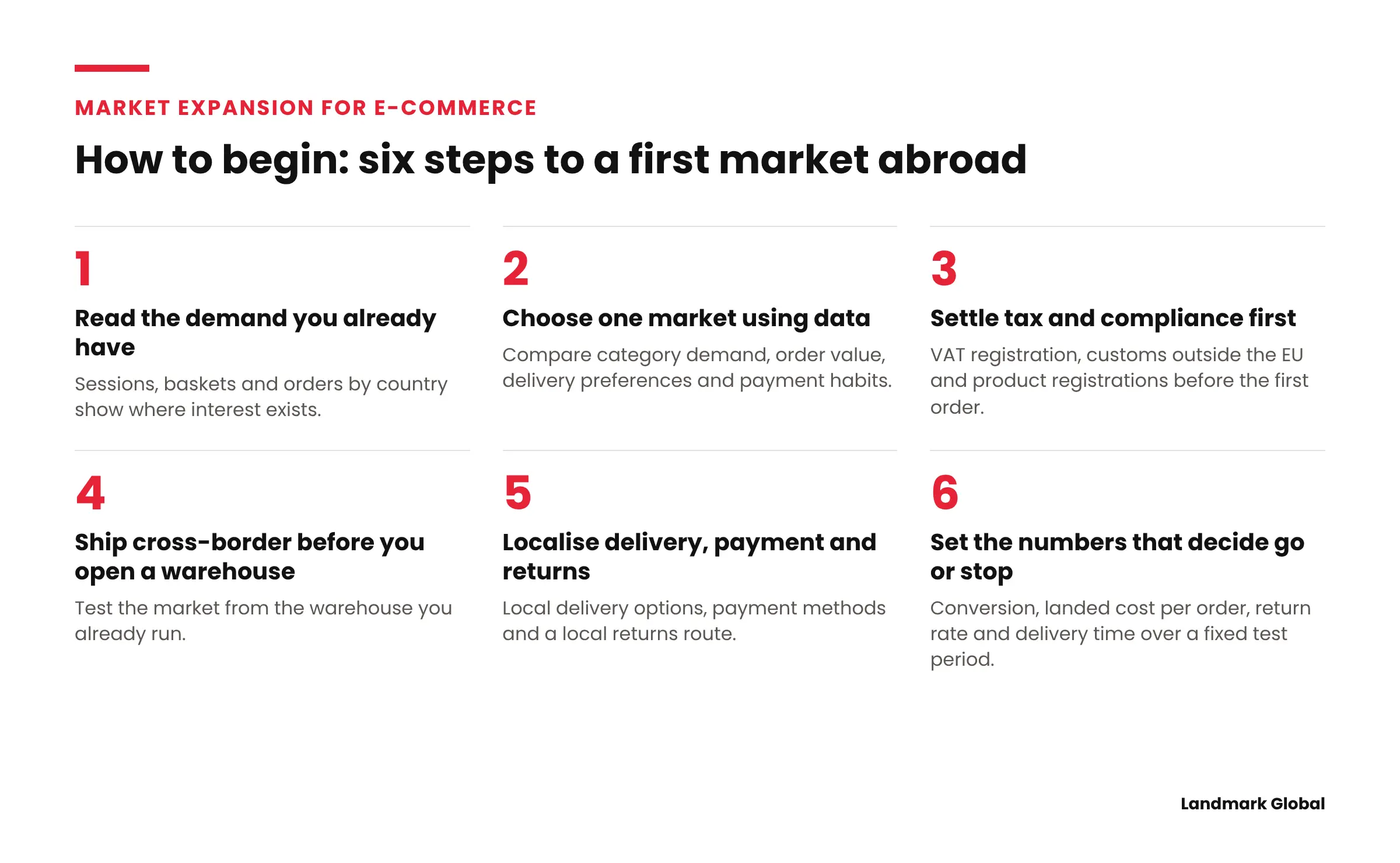
How to Begin Market Expansion: Six Steps
1. Read the Demand You Already Have
Start with your own data. Sessions, abandoned baskets and orders by country show where interest exists before you spend anything on marketing there. Countries that already send you orders without local marketing are the ones to test first.
2. Choose One Market Using Data
Compare the shortlist on category demand, order value, delivery preferences and payment habits. Landmark Global's country factsheets cover the first three. Payment habits vary widely, as the overview of preferred payment methods across Europe shows, with iDEAL in the Netherlands and Kauf auf Rechnung in Germany. Expanding into one market at a time keeps each launch measurable.
3. Settle Tax and Compliance Before the First Order
Inside the EU, B2C distance sales are taxed in the customer's country once your cross-border EU sales pass €10,000 a year, reported through the One Stop Shop. Selling into the EU from outside it adds customs. Since 1 July 2026, low-value consignments carry a temporary €3 customs duty per item, and from 1 November 2026 the EU applies a €2 Union handling fee per customs item. In the UK, VAT is charged at checkout on orders up to £135.
Product rules come on top. Germany requires packaging registration in LUCID before you sell to consumers there. Electrical goods need WEEE registration in each EU country you sell to. The General Product Safety Regulation requires a responsible economic operator in the EU for products sold to EU consumers.
The registrations are yours to hold. The clearance that follows is not: Landmark Global's in-house customs teams handle IOSS, DDP and DAP on the lane, so the border step sits with the operator that ships the parcel. These obligations start with the first sale, whatever the volume.
4. Ship Cross-Border Before You Open a Warehouse
A test market does not need local stock. Shipping from your existing warehouse keeps inventory in one place while you learn what sells. Decide early whether customers pay duties on delivery (DAP) or whether you include them in the checkout price (DDP). For B2C orders, DDP avoids a charge at the door that can lead to refused parcels, and Landmark Global can run the lane DDP so the customer sees one delivered price at checkout. Move stock into the market only when demand there is steady enough to keep it selling.
5. Localise Delivery, Payment and Returns
In the UK, 73% of cross-border shoppers want to see delivery charges before they buy, and 60% expect a simple returns process. Offer the delivery options people use in that country. Landmark Global's out-of-home delivery (PUDO) network covers 200,000+ pick-up and drop-off points across 23 European countries and the UK, averaging under 2km from customer homes, so shoppers get lockers and collection points without you signing a separate agreement per country. Customers should never have to post a return to another country themselves. A partner offering returns management can collect returns in the country and ship them back in bulk.
6. Set the Numbers That Decide Go or Stop
Agree four targets before launch: conversion rate, landed cost per order, return rate and delivery time. Landmark Global's Mercury platform reports delivery time, tracking and returns data across the lane in one place, so you measure against those targets rather than stitching numbers together per carrier. Give the test a fixed period, two quarters, for example, so one weak month does not decide it. If a market misses its targets at the end of the test period, close the lane.
What Does Expanding to New Markets Cost Beyond Shipping?
Shipping is the visible cost. The others arrive with the first orders:
- VAT registration and filing, through OSS in the EU or a UK VAT number
- Customs duties and fees on lanes that cross a customs border
- Producer registrations and fees for packaging, electrical equipment and batteries
- Returns transport and handling
- Customer service and content in the local language
Build these into the landed cost per order before you set the local price. Pricing also moves with fuel, capacity and season, and business rates are largely negotiated account by account, so treat any publicly quoted figure as a starting point and request a quote for your own parcel profile.
How Landmark Global Supports a First Market
Landmark Global ships to more than 220 destinations. A test lane runs on the same contract and setup that would carry full volumes later.
| Feature: what Landmark Global runs | Advantage: what it changes | Benefit: what you get |
|---|---|---|
| Carrier-neutral network covering more than 220 destinations | A new market is a new lane on the existing contract | A shorter route to the first order abroad |
| In-house customs clearance covering DDP, DAP and IOSS | Duties and VAT are handled by the team that ships | A delivered price the customer sees at checkout |
| Mercury platform for booking, tracking and reporting | One integration replaces a portal per carrier | Real-time visibility and the numbers that decide the test |
| Returns management with in-country consolidation | Returns travel back in bulk | A local returns address in each test market |
| Specialist onboarding and a named account team | One person owns the launch | Issues in the test period reach someone who knows the lane |
Landmark Global is a Bnode company, formerly part of Bpostgroup, and uses the group's postal network.
Choosing your first market abroad? Request a custom lane proposal from Landmark Global to set up a test lane, with customs clearance and returns arranged for your parcel profile.
Sources:
- Landmark Global, Country Factsheet United Kingdom 2026 https://landmarkglobal.com/uploads/260401_CountryFactsheet_2026_UK_EN_03-1.pdf
- European Commission, The One Stop Shop, https://vat-one-stop-shop.ec.europa.eu/one-stop-shop_en
- European Commission, EU Customs Reform, https://taxation-customs.ec.europa.eu/customs/eu-customs-reform_en
- Directive 2012/19/EU on waste electrical and electronic equipment, Article 17, https://eur-lex.europa.eu/legal-content/EN/TXT/?uri=CELEX:02012L0019-20180704
Frequently Asked Questions
-
Let your own analytics decide the shortlist, then compare markets on category demand, order value, delivery preferences and payment habits before you expand to a different market. Landmark Global's country factsheets cover demand, value and delivery expectations per country, so you test the market with the clearest signal first rather than the one that feels obvious.
-
It depends on registrations more than on shipping. VAT and product registrations can run in parallel with the integration work. A cross-border lane from your existing warehouse is the fastest route, because it needs no local entity and no local stock.
-
No. An EU business can sell to consumers in other member states without a local entity and report VAT through the One Stop Shop. Some obligations still require a local contact, such as an authorised representative for WEEE registration when you sell electrical goods there.
-
Marketplaces bring traffic from day one but own the customer relationship. Your own store keeps the data and the margin, though it needs local marketing. A common route is to test demand on a marketplace and move volume to your own store once it is proven.