Scaling International Returns Across Europe: Key Criteria for Logistics and Operations Leaders
Returns are the part of European expansion that gets scoped last and breaks first. Outbound has a business case behind it. Reverse flow usually inherits whatever the outbound contract includes, which is why international returns management becomes a board-level cost line somewhere around the fourth market. The reverse leg fails in two places: customs and consolidation. Both can be evaluated and scored before you sign.
Key Takeaways
- Reverse logistics fails at scale on customs and consolidation, long before it fails on carrier coverage.
- EU law sets a floor of a 14-day withdrawal right, so return volume is a structural feature of European trading, not a service choice.
- Standard-rate duty and import VAT are often recoverable on a genuine return, and most retailers never claim them. The EUR 3 flat duty is not.
- Charges on parcels imported into the EU are rising, so the cost of every parcel that comes back is rising with them.
- A return that crosses a border one parcel at a time costs multiples of a consolidated in-country return.
- Subsequent purchase behaviour responds to refund speed more than to the cost of the return itself.
Why Does Managing International Returns Break at Scale?
One market is manageable. A national carrier collects, the parcel comes back to your warehouse, finance reconciles it.
Four markets is a different operation. You now have four sets of consumer expectations about drop-off convenience, four VAT positions, and a customs question every time a parcel re-enters the country it shipped from.
The usual failure is not that returns cannot be moved. It is that nobody owns the data linking the outbound shipment to the return parcel. Without that link, duty recovery is impossible and refund timing becomes guesswork.
Scale also changes the cost shape. Individual cross-border returns carry a per-parcel international cost. The same volume consolidated in a local hub and moved once carries a freight cost. That gap widens with every market you add.
What Do EU Rules Require of a Returns Operation?
Three rules set the baseline for any European returns operation.
- Consumers in the EU can return a distance purchase within 14 days, with no reason required. That is a legal floor, and many categories run longer windows to stay competitive.
- Returned Goods Relief covers goods re-imported into the EU in an unaltered state within three years. They come back free of import duty, and often of import VAT, provided the identity of the goods can be demonstrated. That last condition is the operational one: you need shipment-level evidence linking what went out to what came back.
- Charges on parcels imported into the EU are climbing. A simplified duty of EUR 3 per tariff category has applied to low-value consignments since 1 July 2026, after the EUR 150 exemption was removed, and it is not refunded when the goods are returned. From 1 November 2026, the EU is expected to add a customs handling fee of around EUR 2 per item line. This applies regardless of shipment value and requires mandatory product identifiers on every declared item. The final amount will be defined in delegated acts.
In a high-return category those charges attach to volume you will get back, which raises the value of a working recovery process.
What Should You Look For in a Returns Partner?
- First-mile convenience. Shoppers read the returns policy before they buy. Assess the density of drop-off options in each market you sell into, and whether home collection is available where consumers expect it.
- The portal. A white-label returns portal keeps the experience inside your brand and captures the reason code, the customs declaration and the chosen return method at the point of initiation. Reason codes gathered there are the only reliable input into reducing returns later.
- Consolidation. Ask whether the partner operates in-country hubs, whether those hubs sit in a duty-suspended or duty-free position, and what the consolidation frequency is per market. A weekly consolidated movement and a daily one produce very different working-capital profiles.
- Customs and duty recovery. Ask whether duty drawback and credit programmes are handled in-house or referred out, and what evidence the partner retains. A provider running customs clearance and trade services itself can tie the export record to the re-import record without asking you to reconcile two systems.
- Resale. A return that can be graded and resold in the market it came from avoids a second border crossing entirely, which is the same calculation behind local fulfilment versus cross-border logistics.
Provider Spotlight: Landmark Global
| Feature: what Landmark Global runs | Advantage: what it changes | Benefit: what you get |
|---|---|---|
| First-mile network of around 200.000 drop-off locations | Consumers return locally, without a courier booking or a border in the way | Returns policy stops being a conversion objection in new markets |
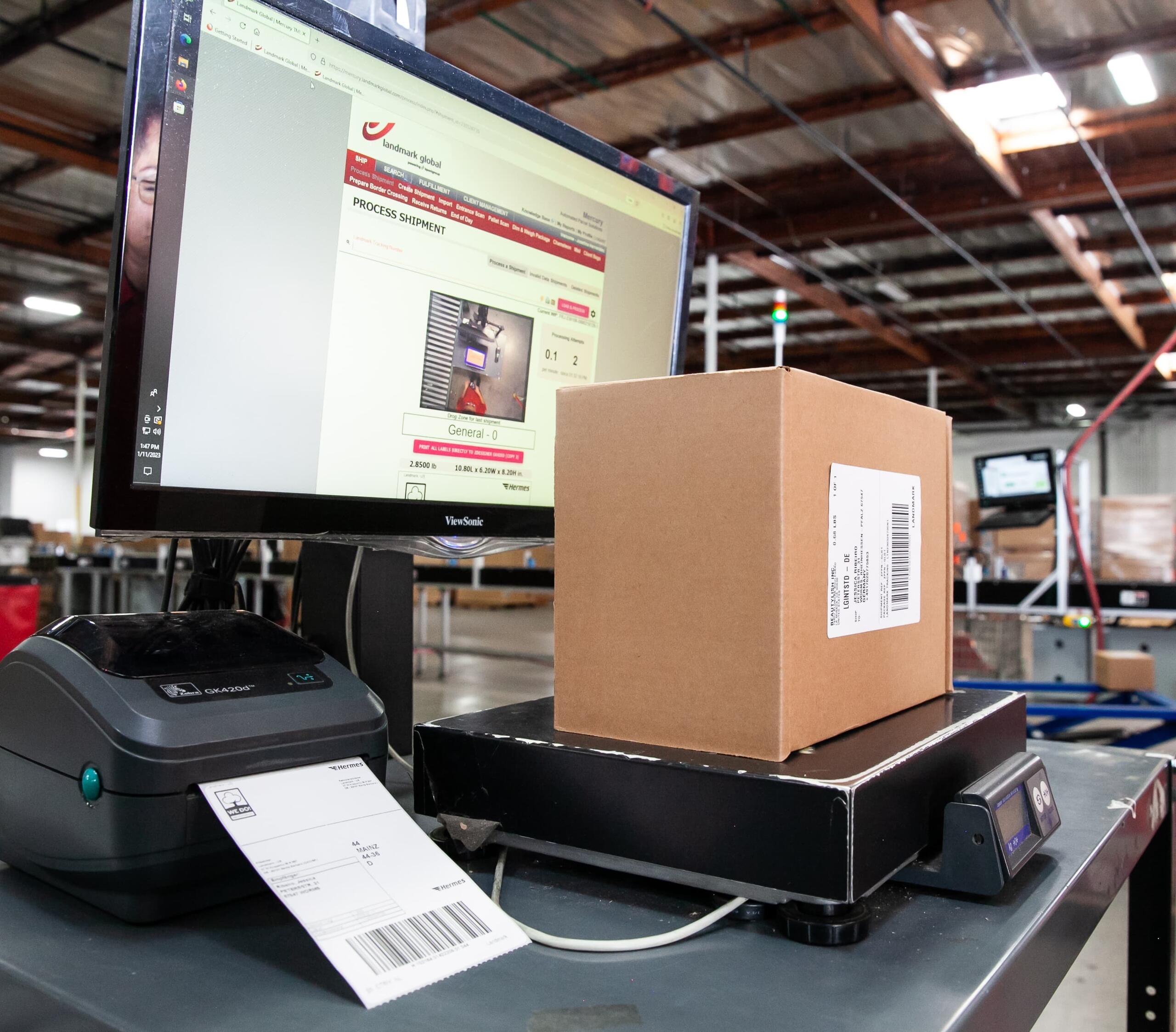
| White-label returns portal generating labels and customs declarations | The return is captured with its data at initiation, instead of reconstructed afterwards | Reason codes and declarations arrive complete, and refunds start sooner |
| In-country consolidation hubs free of duties and taxes | Volume moves once as freight, not parcel by parcel across a border | Materially lower cost per return and a smaller carbon footprint |
| In-house customs clearance with duty drawback, credits and reporting | Recovery is run by the party holding the export record, where a briefed broker works only from your summary | Recoverable duty and VAT on genuine returns stop being a write-off |
| Full end-to-end tracking on the return leg, with consumer notifications | The reverse parcel is visible to both sides throughout | Fewer refund enquiries and a shorter dispute window |
Landmark Global also handles delivery to your own warehouse, your 3PL or a regional hub, and can route returns to a third country, alongside its outbound international parcel delivery network. Onboarding runs through a specialist team, and clients get named account management. Separately, being part of bnode gives the business the infrastructure and purchasing power of an international group.
Questions to Put to a Returns Provider
Four questions separate a workable answer from a good pitch.
- Which markets have in-country consolidation today, and which have it only on a roadmap?
- What is the median time from consumer drop-off to refund trigger, by market?
- Who files the duty recovery claim, and who keeps the evidence?
- What happens to a return that arrives damaged?
Building a Returns Operation That Survives the Next Three Markets
The retailers who scale returns well treat the reverse leg as part of the same contract as the outbound one, with the same data underneath both. Ask for a test lane on your two highest-return markets. The two things to get in writing are who files the duty recovery claim and what the reporting shows you each month. Landmark Global's international returns management can be scoped that way before you commit volume.
Sources:
- Directive 2011/83/EU on consumer rights, right of withdrawal on distance contracts
- European Commission, relief from import duty on returned goods
- Council of the European Union, customs duty rules for small parcels, February 2026
- Landmark Global, EU Customs Reform: Product Identifiers and New Customs Handling Fee applicable for all B2C Distance Sales into the EU from 1 November 2026, August 2026
Frequently Asked Questions
-
Often, yes. Returned Goods Relief covers goods re-imported in an unaltered state within three years, and duty drawback schemes cover other cases. Two constraints apply. The first is evidential: you need records identifying the returned item as the one originally exported. The second is the EUR 3 flat duty on low-value consignments imported into the EU, which is not refunded when the goods go back.
-
EU consumers have at least 14 days from receipt to return an online order without giving a reason, under the EU right of withdrawal. However, retailers frequently extend this period to 30 days or more in competitive categories. Operations should be built to support these longer windows, as 14 days serves only as the statutory minimum.
-
Moving parcels across a border one at a time. Consolidating in-country and shipping back as freight, or reselling in-market, removes most of that cost. The second driver is refund delay, which never appears on a logistics invoice but shows up in repeat purchase rates.